
Domestic Cricket Round-Up: Big Hundreds, Late Drama and Decisive Bowling Shape the Results
A packed day of domestic cricket delivered explosive batting, sharp spells and several tense finishes. Chhattisgarh, Andhra Pradesh, Bengal, Bihar, Vidarbha, Punjab, Rajasthan, Puducherry, Baroda, Haryana and Mumbai all had reasons to celebrate, with individual performances repeatedly shifting the course of their matches. For fans following the results—and weighing up their next cricket prediction—the day offered a reminder that a strong total is never a guarantee, especially when a chase has depth and the final overs remain.
Tiwari’s century powers Chhattisgarh past Odisha
Chhattisgarh captain Vikalp Tiwari produced one of the day’s standout innings, striking 119 from just 56 balls to lead his side to a commanding 228/4 and a 51-run victory over Odisha. Chhattisgarh had lost a wicket almost immediately, leaving Tiwari to steady the innings before turning the contest into a showcase of attacking batting.
He struck 18 boundaries and three sixes, combining placement with power to keep the scoring rate high. Tiwari eventually retired hurt, but by then he had given his team a formidable platform. Odisha faced a steep chase and could not make up the difference, underlining how valuable an early innings recovery can be when a side loses a wicket in the opening over.
Andhra Pradesh holds off Basith’s late charge
Kerala came close to making a contest of its chase against Andhra Pradesh, but fell 29 runs short while pursuing 226. Abdul Basith was outstanding, finishing unbeaten on 70 at a strike rate of 200. His late hitting kept Kerala’s hopes alive, though the target had been built on a powerful and balanced Andhra batting effort.
Opener Shaik Rasheed scored 60 from 39 deliveries, providing a brisk start, while Seeram Venkata Rahul added 64 from only 30 balls. K. S. Narasimha Raju then supplied a crucial burst at the finish, smashing three sixes in a seven-ball cameo worth 20. Those contributions gave Andhra the runs it needed to withstand Basith’s assault.
Bengal cruise as Easwaran and Porel build a partnership
Bengal made light work of a 149-run target, defeating Jharkhand by seven wickets. Abhimanyu Easwaran anchored the chase with an unbeaten 61 from 48 balls, while Abishek Porel contributed 49 off 34. Their 92-run partnership took control of the innings and left Bengal well placed to finish the job without a late scramble.
The stand was a useful example of how a measured partnership can settle a chase. Rather than relying on one batter to force the pace, Easwaran and Porel kept the required rate manageable while punishing opportunities to score.
Bihar stun Delhi in a last-over thriller
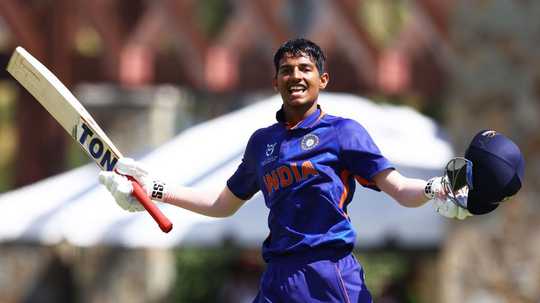
One of the day’s most dramatic results came in Indore, where Bihar chased down Delhi’s imposing 225-run target with one ball remaining. Yash Dhull appeared to have placed Delhi in a commanding position, scoring 125 from 59 balls with 16 boundaries and seven sixes. His innings gave Delhi a total that would have looked difficult to chase on paper.
Bihar’s pursuit was far from smooth. A middle-overs collapse saw the side lose four wickets for just 21 runs, threatening to undo its strong start. However, contributions from across the batting order helped Bihar recover and keep the chase alive. The finish showed why match prediction can be difficult in high-scoring cricket: even a brilliant individual century may not be enough when the opposition finds a way to share the scoring burden.
Taide leads Vidarbha through a tense chase
Vidarbha secured a three-wicket win over Hyderabad at Eden Gardens, with captain Atharva Taide producing the innings that held the chase together. His 82 from 45 balls kept Vidarbha moving despite regular wickets and Hyderabad’s efforts to apply pressure.
Taide’s innings was especially important because the chase never became entirely comfortable. Hyderabad’s bowlers continued to take wickets, but Vidarbha’s captain combined urgency with enough composure to prevent the required rate from getting out of reach.
Punjab and Rajasthan make short work of their targets
Punjab chased Railways’ 168 in under 14 overs, powered by a rapid 122-run partnership between Uday Saharan and Anmolpreet Singh. Saharan struck 73 from 32 balls, while Anmolpreet remained unbeaten on 78 from 40. Together, they hit 12 sixes and 10 boundaries, transforming what could have been a competitive target into a one-sided chase.
Rajasthan also produced an emphatic pursuit, reaching Chandigarh’s target of 194 in under 18 overs for a seven-wicket win. Abhijeet Tomar led the way with 80 from 42 deliveries, while Kartik Sharma added a valuable 38 from only 17 balls. Sharma’s three sixes and two boundaries gave Rajasthan a late acceleration that helped close the match quickly.
Puducherry, Baroda and Haryana win through key contributions
Puducherry set Assam a challenging target of 193/6, thanks in large part to captain Aman Khan and Parameeswaram Sivaraman. Khan scored 55 from 32 balls and Sivaraman made 53 off 43, combining for a match-defining 98-run fourth-wicket stand. Their partnership helped Puducherry recover and build a total with enough depth to put Assam under pressure.
Baroda’s victory over Uttar Pradesh was shaped by Atit Sheth’s destructive new-ball spell. Sheth took three wickets inside the Powerplay, reducing UP to 28/5 and leaving the batting side with too much ground to recover. Early wickets can be decisive in limited-overs cricket, and Baroda’s attack made sure the advantage was not surrendered.
Haryana defeated Tamil Nadu by seven wickets after Yuzvendra Chahal and Nishant Sindhu claimed three wickets apiece. Chahal returned figures of 3/15 and Sindhu took 3/22, restricting Tamil Nadu to 124. Sindhu then added an unbeaten 37 from 29 balls as Haryana completed the chase in 16.1 overs.
Patil makes his mark with bat and ball
Mumbai successfully defended 207 against Goa, with Sairaj Patil influencing the match in both innings. Batting at No. 8, he struck 40 from 21 balls to lift Mumbai beyond 200. He then returned to take 3/27 from three overs, helping restrict Goa to 189.
Across the day’s fixtures, the decisive factors were clear: quick starts, partnerships under pressure and bowlers who could strike at crucial moments. For followers tracking domestic cricket and considering a match prediction, these results offer plenty to assess—but they also highlight the sport’s unpredictability. Big totals can be chased, early collapses can be repaired, and one timely spell can change the outcome.