
Pakistan and Sri Lanka Play Out Draw in Rawalpindi After Saud Shakeel’s Gritty 97
Pakistan and Sri Lanka’s first Test in Rawalpindi ended in a draw after a tense final-day morning briefly raised the prospect of a result. Pakistan lost four wickets in a short burst, but Saud Shakeel steadied the innings with a determined 97, leaving Sri Lanka with too little time to turn their promising start into a realistic victory push.
The match was shaped as much by the weather as by the players. Nearly 120 overs were lost to bad light during the Test, sharply limiting the time available to force a result. With both sides producing substantial first-innings totals, a draw had looked the likeliest outcome before the final day. Sri Lanka’s early strikes made the finish more compelling, but Pakistan’s middle and lower order absorbed the pressure and ensured the visitors could not build on their momentum.
Sri Lanka Strike Early to Put Pakistan Under Pressure
Pakistan began the final day with a lead, but it was not yet large enough to remove all doubt. Sri Lanka’s bowlers found movement and made excellent use of the morning conditions, quickly exposing Pakistan’s top order. Lahiru Kumara dismissed Azan Awais, and Asitha Fernando followed up in the next over by removing Mohammad Taha. The rapid double blow left Pakistan needing to rebuild before the match slipped beyond their control.
The pressure continued as Sri Lanka claimed further wickets. Babar Azam offered a counterattacking response, finding boundaries through the off side and off his pads to keep the scoreboard moving. Shakeel, by contrast, focused on occupying the crease and limiting risk. Their fourth-wicket stand added 50 runs and helped Pakistan recover, though Milan Rathnayake eventually broke the partnership by dismissing Babar for 34.
Rathnayake struck again soon afterwards, sending Salman Agha back for 13. At 125 for five, Pakistan had lost half their side, and Sri Lanka had a genuine opening. Another quick breakthrough or two could have brought the visitors firmly into contention. Instead, Shakeel found a dependable partner in Ghazi Ghori, and the match began to turn back towards a draw.
Shakeel and Ghori Drain the Clock
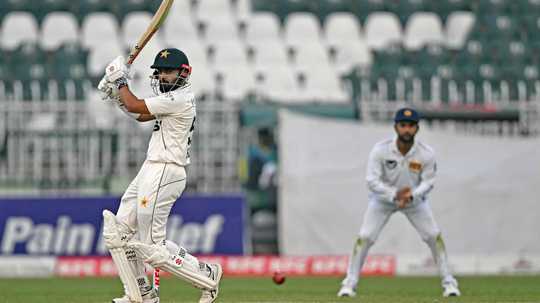
Shakeel and Ghori added 92 runs for the sixth wicket in a partnership that was valuable not only for the runs it produced but also for the time it consumed. Ghori scored 35, supporting Shakeel’s careful approach as Pakistan’s lead moved beyond 200. Their stand lasted 156 deliveries, taking a significant portion of the remaining match time out of Sri Lanka’s reach.
Rathnayake ended Ghori’s innings, but Pakistan’s lower order continued to offer resistance. Arafat Minhas contributed 16 during a 44-run partnership with Shakeel before Dhananjaya de Silva claimed his wicket. By then, Pakistan had built a substantial advantage, and the clock was becoming an increasingly important factor. Sri Lanka needed wickets quickly, while Pakistan’s priority was to stay at the crease and protect its lead.
Shakeel remained composed as he moved through the nineties. Having scored 93 in Pakistan’s first innings, the left-hander had another opportunity to reach a Test century. He faced 210 deliveries and struck seven boundaries, combining patience with timely scoring. The milestone, however, remained just out of reach: Lahiru Kumara bowled him for 97, ending a determined innings that had effectively secured the draw for Pakistan.
Draw Agreed as Pakistan’s Lead Reaches 272
The teams shook hands immediately after Shakeel’s dismissal, with Pakistan’s lead standing at 272. Although the hosts had lost eight second-innings wickets, Sri Lanka had neither enough time nor a practical opportunity to chase down the target. The final-day drama ultimately changed the tone of the finish rather than the outcome, as Pakistan’s resistance ensured the visitors’ early breakthrough did not become a match-winning surge.
Pakistan declared its first innings at 434 for nine, with Shakeel top-scoring with 93. Sri Lanka replied with 446, gaining a narrow lead of 12 runs. De Silva’s 167 and Kusal Mendis’s 119 anchored the visitors’ innings, while Pakistan’s Saqib Khan claimed seven wickets for 130 runs in a notable bowling performance. The match then moved into a second-innings contest that Pakistan closed at 284 for eight declared, with Shakeel again leading the way.
For Sri Lanka, Rathnayake’s three wickets for 47 in the second innings were central to the final-day pressure. Asitha Fernando had also taken three wickets in Pakistan’s first innings. Yet the visitors could not sustain their attack long enough to remove the remaining batters or create a finish before time ran out.
What the Rawalpindi Test Means for the Series
The result reflected a closely balanced contest in which both teams had reasons for encouragement. Sri Lanka’s first-innings batting showed its ability to build a commanding total, while Pakistan’s bowlers—led by Saqib—demonstrated that they could make regular breakthroughs. Pakistan, meanwhile, showed resilience under pressure, particularly through Shakeel’s two substantial contributions and the lower order’s ability to bat out the closing stages.
For supporters following the series, the match also offers useful context for any future cricket prediction. Rawalpindi’s lost overs made it difficult to assess how either side might perform in a full-length, uninterrupted Test, and the drawn result should not be read as a clear indication of dominance. Sri Lanka’s strong batting and early final-day wickets are positives, while Pakistan can take confidence from its bowling return and its ability to recover from 125 for five.
The first Test therefore ends without a winner, but not without meaningful clues for the matches ahead. Sri Lanka will look to convert promising spells into sustained pressure, while Pakistan will want to build on the discipline shown by Shakeel and the lower order. If the next Test offers better conditions and more uninterrupted play, both teams should have a clearer chance to turn their strengths into a decisive result.
First Test: Brief Scores
Pakistan: 434/9 declared (Saud Shakeel 93; Asitha Fernando 3/107) and 284/8 declared (Saud Shakeel 97, Babar Azam 34; Milan Rathnayake 3/47).
Sri Lanka: 446 (Dhananjaya de Silva 167, Kusal Mendis 119; Saqib Khan 7/130). Result: Match drawn.