
Pakistan End Two-Year Test Drought With Eight-Wicket Win Over Sri Lanka
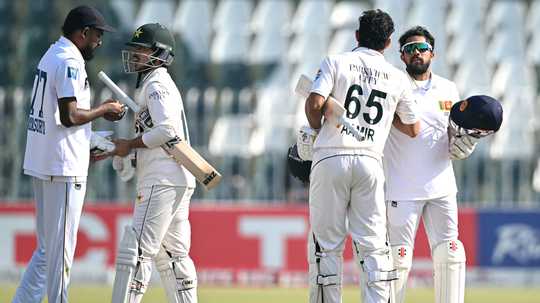
Pakistan finally have a reason to celebrate in Test cricket. After a difficult World Test Championship cycle marked by defeats, controversy and changes in personnel, the hosts secured their first Test series victory in two years by beating Sri Lanka by eight wickets in the second Test at Rawalpindi. The result gave Pakistan a 1-0 series win and offered a timely lift to a side seeking stability and renewed confidence in the longest format.
Set a target of just 90, Pakistan needed only 13 overs to finish the chase on the fourth morning. Their quick, assured response capped a match in which Mohammad Abbas and Aamer Jamal made decisive contributions with the ball, while Pakistan’s lower order helped establish a crucial first-innings lead.
Abbas finishes the Sri Lankan innings
Pakistan began the morning needing one final wicket to dismiss Sri Lanka in their second innings. It took only two overs to complete the job. Milan Rathnayake struck a boundary from the last delivery of the first over, leaving Asitha Fernando with the task of surviving the next.
Mohammad Abbas kept the pressure on with a short delivery that was called wide for height. The extra ball proved decisive: Abbas found movement away from Fernando, who was struck in front of the stumps. The batter was trapped plumb, bringing Sri Lanka’s innings to an end and leaving Pakistan with a modest target.
Abbas finished with three wickets for 55 runs in the second innings, adding to his three for 14 in the first. His control and ability to make the ball move were central to Pakistan’s bowling effort, particularly after Sri Lanka had recovered from a poor start to post a more competitive second-innings total.
Jamal’s aggressive approach seals the chase
Pakistan’s openers made their intentions clear from the outset. Azan Awais and Tayyab Arif both got off the mark with boundaries, and although Fernando found ways to beat the bat after adjusting his length, the hosts continued to score freely. The target was small enough that Pakistan did not need to take undue risks, but the regular boundaries kept the required rate comfortably under control.
The chase briefly became more complicated when Pakistan lost two wickets in quick succession. Arif played inside the line of a delivery from Lahiru Kumara and was bowled, while Fernando trapped Mohammad Taha leg before wicket. Ball-tracking confirmed that the delivery would have clipped leg stump, leaving Pakistan two down but still well placed.
Aamer Jamal was promoted to No. 4, a decision that quickly paid off. He attacked from the moment he arrived, driving a boundary through the covers before pulling a short ball for six. Awais, meanwhile, continued to find the boundary with composed, technically sound strokes. Pakistan moved at more than a run per ball, turning the pursuit into a brief and emphatic finish rather than a tense final-day test.
Jamal remained alert to anything short and punished it decisively. With only a handful of runs left, Sri Lanka turned to left-arm spinner Prabath Jayasuriya. Jamal attempted a reverse-sweep, then stepped down the pitch and launched the ball over wide long-on to complete the victory. He finished unbeaten on 34, while Awais was 32 not out.
Pakistan’s first-innings lead proves vital
The match was shaped by Pakistan’s ability to build a substantial advantage after dismissing Sri Lanka for just 98 in the first innings. Abbas and Razaullah claimed three wickets apiece, restricting the visitors and putting Pakistan in a position to control the contest.
Pakistan replied with 325, earning a lead of 227 runs. Ghazi Ghori top-scored with 54, while Awais contributed 47. Sri Lanka’s Lahiru Kumara took five wickets for 95, and Fernando claimed three for 88, but Pakistan’s total gave their bowlers a significant cushion.
Sri Lanka showed greater resistance in their second innings, reaching 316. Rathnayake led the recovery with 66, while Sonal Dinusha added 54. Their partnership helped restore some respectability after the first-innings collapse and briefly raised the possibility of a more demanding chase. Pakistan, however, kept taking wickets at key moments. Abbas and Jamal each claimed three, ensuring the target remained within reach.
A timely boost for Pakistan’s Test campaign
The series win carries significance beyond the result itself. Pakistan had endured a turbulent stretch in Test cricket, and a home victory offers both players and supporters a welcome change in momentum. Winning the second Test so decisively also underlined the value of a balanced performance: the bowlers created the opportunity, the batting produced a useful first-innings advantage, and the chase was completed with composure.
For Sri Lanka, the match highlighted the cost of a first-innings collapse, even though their second-innings fightback provided encouraging contributions from Rathnayake and Dinusha. The visitors’ bowlers also had moments of success, with Kumara’s five-wicket haul keeping Pakistan from building an even larger total.
Looking ahead, this result gives Pakistan a platform to build on as the World Test Championship cycle continues. Any cricket prediction about the team’s longer-term prospects will depend on whether they can reproduce this level of discipline and consistency across future matches. For now, the immediate achievement is clear: Pakistan have ended a two-year wait for a Test series triumph, and they did it with a commanding win in Rawalpindi.
Match summary
Sri Lanka: 98 (Kusal Mendis 32; Mohammad Abbas 3-14, Razaullah 3-21) and 316 (Milan Rathnayake 66, Sonal Dinusha 54; Mohammad Abbas 3-55, Aamer Jamal 3-67).
Pakistan: 325 (Ghazi Ghori 54, Azan Awais 47; Lahiru Kumara 5-95, Asitha Fernando 3-88) and 90/2 (Aamer Jamal 34 not out, Azan Awais 32 not out; Lahiru Kumara 1-27, Asitha Fernando 1-30).
Result: Pakistan won by eight wickets and claimed the series 1-0.