
Speed Chess Championship 2026: First-Round Matchups, Predictions and Players to Watch
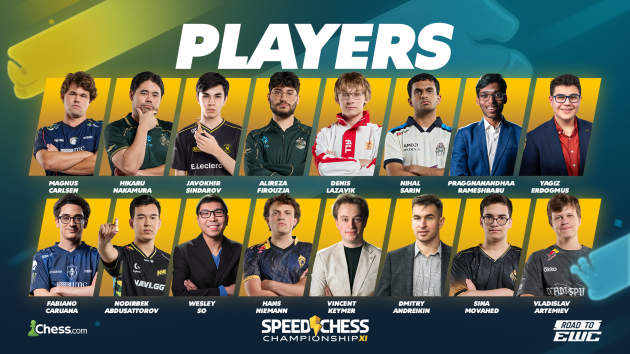
The 2026 Speed Chess Championship is set to begin on November 16, bringing 16 elite players together for a high-stakes knockout event. Each competitor will be aiming to win four matches, claim the largest possible share of the $250,000 prize fund and collect valuable Champions Chess Tour standings points on the road to the 2027 Esports World Cup.
The opening round offers a compelling mix of established champions, rising teenage talents and closely matched world-class rivals. Some pairings look heavily one-sided on paper, while others could go either way. The predictions below, calculated by NM [name not provided], estimate each player’s chance of winning and the projected match score. They are forecasts, not guarantees: in fast chess, a single tactical mistake or time scramble can quickly change the story.
Hikaru Nakamura vs. Yagiz Kaan Erdogmus
The championship opens with a meeting between two generations of chess. Hikaru Nakamura, a five-time Speed Chess Championship winner, faces 15-year-old grandmaster Yagiz Kaan Erdogmus, the youngest player in this year’s field.
The numbers give Nakamura a commanding advantage, assigning him a 96% chance of victory and a predicted score of 16.5–7.5. Erdogmus is the clear underdog, but the format leaves room for surprises. Speed chess rewards quick calculation and practical decision-making, qualities that can help a young player turn a difficult match into an opportunity. Even so, Erdogmus will need an exceptional performance to stop one of the event’s most accomplished competitors.
Magnus Carlsen vs. Sina Movahed
Another veteran-versus-youngster contest pairs former world champion Magnus Carlsen with Sina Movahed, one of the youngest players in the tournament. Carlsen is the strong favorite, with a 91% projected chance of winning and an expected score of 14.5–9.5.
Movahed, however, is not simply a promising newcomer. He has won three Titled Tuesday events in 2026, a record matched by only one other player in the field. That success suggests he is comfortable competing online under pressure—the same environment in which the Speed Chess Championship thrives. The model gives him roughly a one-in-11 chance of an upset. Carlsen remains the obvious pick, but Movahed has enough speed and confidence to make the match worth watching.
Alireza Firouzja vs. Vladislav Artemiev
Alireza Firouzja meets Vladislav Artemiev in a clash between two highly experienced grandmasters who are still in their twenties. Firouzja, 28, enters as the statistical favorite, with a 93% chance of advancing and a projected 15.5–8.5 score.
Those figures suggest a more decisive advantage than the prediction gives Carlsen in his match. Yet Artemiev’s reputation as a resourceful and dangerous player makes this pairing difficult to dismiss. A strong start could help Firouzja build momentum, but Artemiev’s ability to find practical chances may make the contest closer than the percentages imply. For viewers, this is a useful reminder that prediction models capture past performance and expected outcomes—not every tactical twist of a live match.
Denis Lazavik vs. Dmitry Andreikin
At 19, Denis Lazavik is already an experienced name in both the Speed Chess Championship and the Esports World Cup. He faces Dmitry Andreikin, a veteran of online chess who has collected an impressive number of Titled Tuesday victories.
Lazavik, the 2026 EWC finalist, is favored to win 71% of the time, with a projected score of 13.5–10.5. That still leaves Andreikin with a meaningful 29% chance of advancing. His online experience could prove especially valuable in a match where preparation, clock management and the ability to recover after a loss all matter. Lazavik may have the stronger forecast, but Andreikin has the tools to make him work for every point.
Wesley So vs. Praggnanandhaa Rameshbabu
This matchup brings together Wesley So, 33, and 21-year-old Praggnanandhaa Rameshbabu. So has enjoyed a productive 2026, winning multiple tournaments and making a strong impression in Grandmasters. Praggnanandhaa, meanwhile, has already gained experience in multiple Candidates Tournaments despite his age.
The prediction model sees a competitive contest, giving Praggnanandhaa a 61% chance of victory and a projected 13–11 score. So is far from out of the running, with a 39% chance of advancing. The modest gap points to a match where momentum could shift repeatedly. Both players have the positional understanding to navigate complex games, but the shorter time controls may reward whichever competitor can stay accurate while making decisions quickly.
Nihal Sarin vs. Hans Niemann
Nihal Sarin and Hans Niemann meet in a pairing that highlights the speed and intensity of online chess. Sarin is favored, with a 68% chance of winning and a projected score of 13.5–10.5. Niemann’s estimated chance stands at 32%.
That advantage makes Sarin the statistical choice, but Niemann is known for fighting through difficult positions rather than conceding easily. In a multi-format match, players must adjust as the pace changes, and a strong run in one segment can put pressure on the opponent. If Niemann can disrupt Sarin’s rhythm early, the forecast may matter less than the momentum at the board.
Nodirbek Abdusattorov vs. Vincent Keymer
Two members of the world’s top 10, Nodirbek Abdusattorov and Vincent Keymer, meet in one of the round’s most intriguing matchups. Both are young stars with the potential to remain major forces in chess for years to come.
Abdusattorov receives a narrow edge, with a 58% chance of winning and a projected 12.5–11.5 score. Keymer’s 42% probability makes this one of the most competitive pairings of the opening round. The prediction is close to a coin flip, and the match may come down to small details: who handles time pressure better, who converts winning positions, and who can recover fastest after a setback.
Fabiano Caruana vs. Javokhir Sindarov
Fabiano Caruana and Javokhir Sindarov provide the other first-round showdown between current top-10 players. The match also sets a veteran contender against a younger rival whose profile could rise further depending on his results in major events later in the year.
This is the closest matchup in the model: Sindarov has a 53% chance of winning, compared with Caruana’s 47%, and the projected score is 12.5–11.5. Such a narrow margin offers little basis for a confident prediction. Caruana’s experience is a significant asset, while Sindarov’s recent form and ambition could make him a formidable opponent. Expect a contest in which every game—and every missed chance—could matter.
What to Expect from the Speed Chess Championship
The first round sets up a tournament defined by contrasts: established champions against emerging talents, close top-10 battles and players with proven online records. The eight winners will advance to the quarterfinals, with the remaining competitors eliminated from the championship bracket. The semifinal and final stages are scheduled to take place in London in February.
For chess fans, the predictions offer a useful preview, but the appeal of speed chess lies in its unpredictability. Rapid calculations, sudden tactical shots and shifting clock pressure can overturn even a strong statistical advantage. Follow the opening round on November 16 and throughout the event for updates, broadcast information and the latest results.