
Carlsen and Abdusattorov Prepare Together for Budapest’s New Chess Format
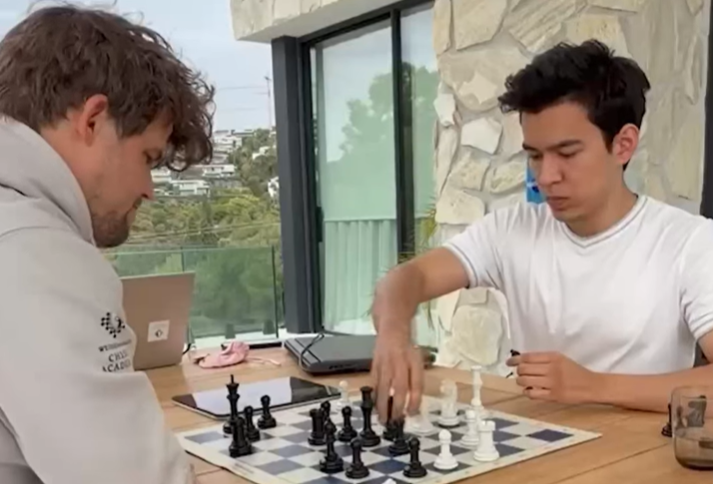
Two of the strongest players in modern chess are sharing a training board rather than keeping their preparation private. Magnus Carlsen and Nodirbek Abdusattorov have joined forces at Carlsen’s holiday home in Spain, where they are preparing for a major tournament in Budapest scheduled for November 10–20.
The unusual training partnership brings together the former world champion and one of the game’s leading young stars. They are expected to compete among a 24-player field in an event designed to test a hybrid format combining fast classical chess, rapid, and blitz. The Budapest tournament is also intended as a trial for a FIDE-approved tour set to launch in 2027, with the longer-term goal of crowning a World Combined Champion.
A Rare Look Inside Elite Chess Preparation
A post shared on Carlsen’s social media accounts on Saturday offered a glimpse of the camp. The post featured three photographs, including images of grandmasters David Howell and Peter Heine Nielsen, as well as a video of Carlsen and Abdusattorov playing blitz. Its understated caption—“Someone brought a chess board into this house”—hinted at the serious work taking place behind the relaxed setting.
Training together is notable because the two players are not simply teammates. Carlsen has been one of the defining figures in world chess for nearly two decades, while Abdusattorov, ranked fifth in the world, is widely viewed as part of the next generation capable of challenging the established elite. They may soon face one another in Budapest, making their decision to exchange ideas and play practice games especially striking.
Top players often guard their opening preparation and strategic discoveries closely. A shared camp can offer valuable benefits, but it also requires trust: each grandmaster must be comfortable revealing how they think, where they feel confident, and which positions they prefer. Their collaboration suggests that preparation for this event may be as much about adapting to its unusual rules as it is about preparing for individual opponents.
Two of the World’s Best Blitz Players
The pairing also makes practical sense. Carlsen and Abdusattorov are both renowned for their speed chess, and bringing together two of the world’s highest-rated blitz players should create an exceptionally demanding training environment. Blitz games reward rapid calculation, pattern recognition, and the ability to make sound decisions under severe time pressure—skills that could prove decisive in a tournament spanning several time controls.
Abdusattorov arrives with strong recent form. After finishing 2025 with the year’s highest performance rating, the Uzbek grandmaster carried that momentum into 2026 with further impressive results. His rise has been built on more than tactical sharpness: he has shown composure in high-pressure situations and an ability to seize opportunities when opponents lose control of a position.
Carlsen has praised those qualities for years. Abdusattorov first drew widespread attention after winning the World Rapid Championship as a 17-year-old, a breakthrough Carlsen described on social media as an “absolutely incredible achievement.” In a 2023 interview with Sjakksnakk, Carlsen highlighted the younger player’s concentration and discipline.
Carlsen later offered another assessment during Chess.com’s Tata Steel Chess broadcast, describing Abdusattorov as ruthless once he gains a chance. He noted the Uzbek’s precise calculation, feel for momentum, and mental strength—traits that can be particularly valuable in a mixed-format event, where players must repeatedly adjust their approach.
How the Budapest Tournament Will Work
The Budapest competition is designed to test more than conventional classical preparation. The event begins with a blitz Swiss tournament, which will help establish tiebreak rankings. Players then move into a fast classical group stage, with games played at a time control of 45 minutes plus a 30-second increment per move.
After the group stage, the leading contenders will advance to knockout matches that combine all three formats: fast classical, rapid, and blitz. The different time controls will not carry equal weight, with victories in the longer games counting more heavily. That structure is intended to reward players who can balance deep strategic play with the speed and flexibility required in shorter games.
For competitors, the format presents a distinct challenge. A player who excels in blitz cannot rely on quick instincts alone, while a classical specialist may need to make faster decisions than usual. Success will depend on managing energy, shifting between styles, and understanding when to take risks. The format may also make match preparation less predictable, since a single opponent could demand very different strategies from one segment to the next.
When his participation was announced in August, Carlsen said, “It’s always interesting to try out new formats.” His comments reflect the experimental nature of the event. If the tournament proves compelling for players and audiences, it could provide useful lessons for the planned 2027 tour and its ambition to recognize excellence across multiple forms of chess.
Carlsen’s History of Training Partnerships
Although this camp is unusual, Carlsen has worked with rising players before. He has previously invited young grandmasters to train with him, including promising talents seeking experience against one of the world’s strongest competitors. Earlier in his own career, Carlsen also benefited from being welcomed into the home of a leading player: as a teenager, he trained in Madrid with grandmaster Miguel Illescas.
That history adds another dimension to the Spain camp. Training with an emerging star can provide Carlsen with fresh challenges and new perspectives, while Abdusattorov gains the opportunity to test his ideas against an opponent with extraordinary experience in elite competition. With Howell and Nielsen also present, the camp brings together playing strength, coaching knowledge, and practical preparation.
Whether the collaboration gives one player a decisive edge—or simply helps both arrive better prepared—will become clearer when the Budapest tournament begins on November 10. For chess fans, the partnership offers an uncommon view of how elite grandmasters prepare for a new kind of competition. It also sets up an intriguing possibility: after sharing a board in Spain, Carlsen and Abdusattorov may soon find themselves on opposite sides of one in Budapest.