
Boca Juniors Beat River Plate in a Heated Superclásico at La Bombonera
Boca Juniors claimed a hard-fought 1-0 victory over River Plate in a fiery Superclásico at La Bombonera, where Lautaro Di Lollo’s first-half header proved decisive. The match was shaped by two River dismissals, repeated confrontations and a tense finish, as Boca held on against nine opponents to secure bragging rights in Argentina’s most closely watched football rivalry.
The result was about more than a single goal. In a fixture where momentum and emotion can shift in an instant, Boca made their numerical advantage count, while River’s discipline became a defining problem. The closing stages brought further disorder, including objects thrown toward a sent-off player and a police escort to help him leave the pitch.
Early red card puts River under pressure
River’s afternoon began to unravel within minutes. Lucas Martínez Quarta was penalized for holding Miguel Merentiel as the Boca forward tried to move into a dangerous position. Merentiel went to ground, and after the referee reviewed the incident with the video assistant referee, Martínez Quarta was shown a straight red card.
The decision immediately changed the tactical picture. River had to reorganize with ten players, giving up some of the control and attacking ambition normally expected in a Superclásico. Despite the setback, the visitors still had experienced defenders on the field, including Marcos Acuña and Gonzalo Montiel, and attempted to stay compact rather than allow Boca to exploit the extra space.
That resistance lasted until Boca found a breakthrough from a set piece. Sebastián Villa delivered a corner into the area, and Di Lollo met it with a header that sent the home crowd into celebration. The goal rewarded Boca’s pressure and gave them a valuable lead to defend against a River side already facing a difficult numerical disadvantage.
Di Lollo’s header settles the contest
Di Lollo’s goal was the match’s most important football moment, but it did not bring calm. Boca had the advantage on the scoreboard and an extra player, yet River continued to compete aggressively. The visitors’ defensive experience helped them remain in the contest, while Boca had to balance the desire to attack with the need to avoid giving River a route back into the game.
Set pieces often carry added importance in matches as tightly contested as the Superclásico. With open-play chances difficult to create and emotions running high, one well-delivered corner can decide the outcome. Villa’s delivery and Di Lollo’s finish gave Boca exactly that kind of decisive moment.
For River, conceding after going down to ten men made the task even harder. The team needed to protect its goal while looking for opportunities to counterattack, but the pressure of defending with a reduced lineup left little room for mistakes. Boca’s lead allowed the hosts to manage the match on their terms, even as the atmosphere grew more hostile.
Tempers flare between Argentina teammates
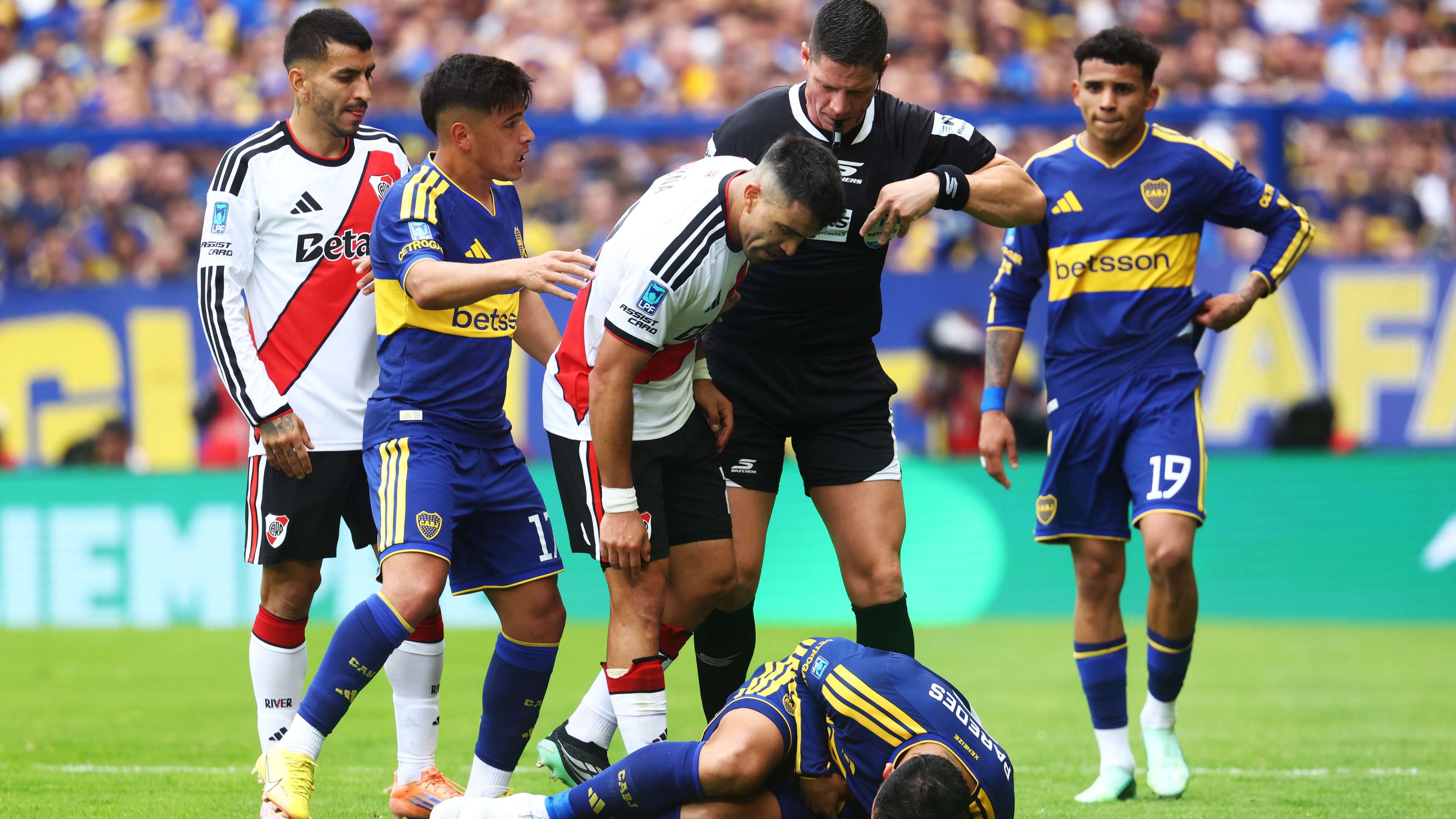
Physical challenges and interruptions became a regular feature as the game wore on. Shortly before halftime, Boca midfielder Leandro Paredes clashed with Acuña, his teammate in Argentina’s victorious 2022 World Cup squad. Both players received yellow cards after the confrontation, a reminder that national-team relationships offered little protection in one of club football’s fiercest rivalries.
There was further debate around the referee’s disciplinary decisions. Lautaro Blanco escaped punishment for a clear-looking foul on an opponent’s foot, while Paredes remained on the field despite a challenge that drew strong protests from River players. Paredes later became involved in a brief scuffle with Nicolás Otamendi, adding to a match already marked by confrontations.
These incidents kept the referee under pressure and made the game increasingly difficult to control. In a Superclásico, every decision is scrutinized by players, supporters and viewers, particularly when a red card has already altered the balance. The stop-start rhythm also made it harder for either team to build sustained attacking momentum.
Montiel dismissal sparks chaotic finish
River’s hopes of finding an equalizer suffered another major blow with roughly ten minutes remaining. Montiel was sent off for a badly timed tackle on Blanco, leaving the visitors with only nine players. The dismissal was especially notable because Montiel had scored the penalty that secured Argentina’s World Cup triumph four years earlier.
As Montiel headed toward the dressing room, objects were thrown in his direction. The situation became serious enough for riot police to escort him from the pitch, underscoring how quickly the atmosphere had escalated. The episode was a troubling end to an already volatile match and shifted attention away from the football itself.
Boca now faced an unusual closing challenge: protecting a narrow lead against a team reduced to nine, while handling the pressure of a hostile, high-stakes derby. River continued to battle, but the numerical gap left them with little opportunity to mount a sustained attack. Boca remained organized and saw out the remaining minutes to complete the 1-0 victory.
What the result means for both sides
The win gives Boca a significant psychological boost, as well as the immediate satisfaction of beating River in front of their home supporters. Di Lollo emerged as the match-winner, while Villa’s corner provided the crucial assist. Boca’s ability to defend their lead after the early dismissal—and through a chaotic final stretch—will be a major talking point in the aftermath.
For River, the defeat will prompt questions about discipline and decision-making. Playing most of the match with ten men was a severe disadvantage, and Montiel’s late red card made a comeback almost impossible. The team’s experienced defenders helped limit the damage, but two dismissals left River with little chance of changing the result.
Any prediction about the teams’ next performances will depend on how they respond to this emotionally draining encounter. Boca can build on a derby win, but will need to maintain consistency beyond the celebration. River, meanwhile, must regroup quickly and avoid allowing frustration to carry into its next fixture. In a rivalry this intense, the scoreline may be settled, but the debate over the decisions, discipline and defining moments is likely to continue well beyond the final whistle.