
Refereeing admissions in Madrid and London reignite football debate
Two high-profile refereeing reviews in Spain and England have put controversial decisions back under the spotlight, raising fresh questions about how officials judge contact, apply disciplinary rules and use video assistant referees. One review concerned a penalty awarded to Kylian Mbappé in Real Madrid’s win over Racing Santander. The other examined Cole Palmer’s dismissal and a penalty appeal during Chelsea’s London derby defeat to Tottenham Hotspur.
The cases are separate, but together they illustrate a familiar tension in modern football: a decision can be judged incorrect after the match while the referee’s choice not to intervene through VAR is still considered acceptable. For supporters, players and coaches, that distinction can be difficult to understand—especially when a call has a direct impact on the result or a player’s availability.
Spanish committee says Mbappé penalty should not have been awarded
Real Madrid beat Racing Santander 3-0 in an 11th-round fixture, but the result was followed by scrutiny of the penalty awarded to Mbappé. Spain’s Technical Committee of Referees reviewed the incident and concluded that the decision was a serious error: the contact between the forward and Racing defender Mateo Prati did not justify a spot-kick.
The admission does not change the scoreline or the official match record, but it does confirm that the referee’s interpretation was wrong. Penalty decisions often hinge on fine details, including who initiates contact, whether a defender’s action prevents an attacker from playing the ball, and whether the contact is sufficient to cause a fall. In this case, the committee’s assessment was that the incident did not meet the threshold for a foul inside the area.
That distinction matters in a game where a penalty can alter the tactical picture. A team that falls behind may have to take more risks, while the side awarded the spot-kick gains a major opportunity to extend its lead. Even when a match ends with a comfortable margin, a later review can still shape discussion about the quality and consistency of officiating.
Premier League panel says Palmer’s first challenge merited a red
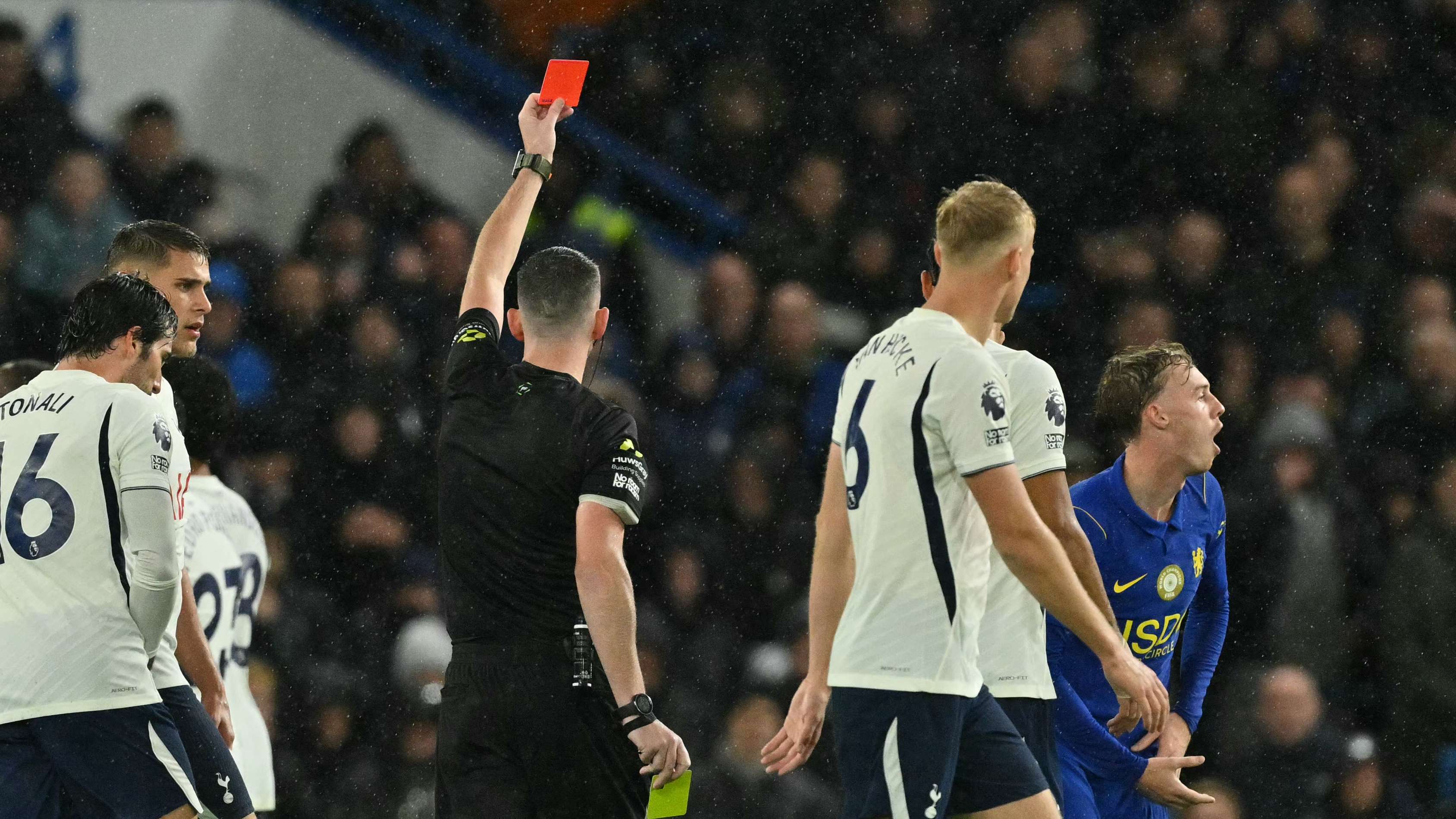
In England, the Premier League’s Key Match Incidents panel reviewed Chelsea’s 2-0 loss to Tottenham on 24 October. The panel focused on two separate incidents involving Palmer, who was sent off after receiving a second yellow card late in the match.
In the 70th minute, referee Chris Kavanagh booked Palmer for a shove on Tottenham midfielder Matheus Fernandes. Palmer was later shown another yellow card for a challenge on Conor Gallagher. The panel’s five members voted 3-2 that the earlier incident against Fernandes should have resulted in a straight red card rather than a booking.
The majority view was that Palmer made deliberate contact with Fernandes’ head and that the action was unnecessary, dangerous and carried out with excessive force. The panel’s published explanation said the contact was clear and that the challenge met the standard for a sending-off.
The outcome has practical consequences beyond the debate over the decision itself. Palmer had already served a one-match suspension, missing Chelsea’s League Cup defeat to Liverpool. Had the first incident been treated as a direct red, he would have faced a three-game ban. That would have made him unavailable for Chelsea’s 2-0 victory over Manchester United, a match in which he scored from the penalty spot, as well as the following league round against Sunderland.
Why VAR did not overturn the booking
Although the panel majority believed Palmer should have been dismissed for the first challenge, all five members agreed that VAR official John Brooks was right not to intervene. The reason was the Premier League’s “clear and obvious error” threshold. In the panel’s view, Kavanagh’s decision to issue a yellow card was not sufficiently clear-cut to require a video review overturn.
This highlights one of the most debated features of VAR in football. The technology is not designed to re-referee every incident or guarantee that every decision is correct. Instead, it is intended to correct clear mistakes in specific situations. As a result, a review panel can later decide that a different outcome would have been preferable while still concluding that the original decision was not an obvious enough error for VAR to step in.
Tottenham penalty appeal also divides the panel
The same derby produced another disputed call. In the 85th minute, Tottenham appealed for a penalty after Chelsea midfielder Moisés Caicedo fouled Dominic Solanke. The panel voted 3-2 that Spurs should have been awarded a spot-kick, arguing that Caicedo repeatedly held Solanke away from the ball and restricted his ability to move forward.
However, the panel also backed the decision not to send the incident to the referee for an on-field review. The majority therefore considered the penalty decision wrong, but not wrong by the standard required for VAR intervention. The split vote underlines how closely balanced judgments about holding and obstruction can be, particularly in crowded penalty areas where contact is brief and players are competing for position.
The controversy did not change the final result. Chelsea goalkeeper Mike Penders turned the ball into his own net in the 77th minute, and Mathys Tel added a late goal to secure Tottenham’s 2-0 victory. The result gave Spurs only their second league win over Chelsea in 36 years, adding another layer of significance to an already eventful London derby.
What the decisions mean for future football predictions
For fans assessing form or making a football prediction, these reviews are a reminder that match outcomes can be shaped by more than tactics and finishing. Refereeing decisions, disciplinary suspensions and the availability of key players can influence what happens in the weeks that follow. Palmer’s potential absence, for example, would have affected Chelsea’s attacking options and the way the team approached its next fixtures.
At the same time, post-match admissions should be treated as context rather than a guarantee that similar decisions will be handled identically in the future. Each incident depends on its own details, and VAR intervention continues to rely on a specific threshold. The Madrid penalty review and the Premier League panel’s findings show that official assessments can offer greater transparency, but they do not eliminate disagreement.
For clubs, supporters and analysts, the central issue remains consistency: players need to know what level of contact is likely to bring a penalty or a red card, while referees need clear standards that can be applied across competitions. Until those expectations are understood in the same way by officials and the public, controversial calls—and the debates that follow them—will remain an enduring part of football.