
Abhishek Sharma’s 113 Powers India to Record-Breaking T20I Win in Wellington
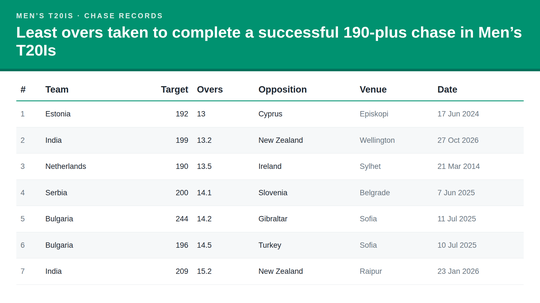
Abhishek Sharma turned a challenging chase into a striking display of power hitting, blasting 113 from just 38 balls as India defeated New Zealand by six wickets in Wellington. His fourth T20I century, combined with a rapid opening stand alongside teenager Vaibhav Sooryavanshi, helped India reach a target of 199 in only 13.2 overs and secure the series with two matches still to play.
The numbers told a remarkable story: India scored 199 for four, with 40 balls remaining, after New Zealand had posted a competitive 198 for three. But the result was shaped early. Abhishek and Sooryavanshi put on 133 runs in just 7.1 overs, transforming the chase into a near-formality before New Zealand could settle into the contest.
A Record-Breaking Powerplay Sets the Tone
India’s opening six overs produced 118 runs, the highest Powerplay total in a match between Full Member teams. The extraordinary start left New Zealand’s bowlers with little room to recover. By the time the opening partnership ended, India needed only 66 more runs from 77 balls.
Abhishek reached his fifty from just 15 deliveries and brought up his century in 35 balls. That left him just short of his own record for the fastest T20I hundred, which he had scored from 30 balls. He also took 15 balls to reach his half-century, preserving Yuvraj Singh’s famous 12-ball T20I fifty record. Yuvraj noted the milestone on social media, but the wider performance was extraordinary in its own right.
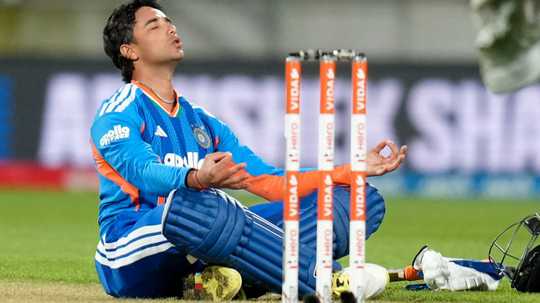
After reaching three figures, Abhishek raised a clenched fist and roared before sitting down in a meditative pose. His innings included 11 sixes, and he scored at a strike rate of 297.37. The celebration matched a knock that seemed to bend the usual limits of T20 cricket.
Sooryavanshi Seizes His Opportunity
India made a notable change at the top of the order, promoting Sooryavanshi and leaving Sanju Samson out of the opening partnership. The teenager responded immediately, showing confidence against New Zealand’s attack. He drove Jacob Duffy over mid-on for four, then sent a six beyond point two balls later.
Abhishek’s first delivery was just as emphatic. He backed away and launched it over the boundary, continuing a remarkable habit: it was the eighth time he had hit a six from his first ball in a T20I. India had 26 runs on the board after the opening over, and the pressure was already moving firmly onto the hosts.
New Zealand tried several bowling options, but none could slow the scoring for long. Adam Milne conceded 17 in the second over, while Michael Bracewell’s offspin went for 21. Kyle Jamieson, brought on as the fourth bowler in as many overs, gave up 20, including two sixes and two fours. India crossed 100 inside five overs, with both left-handed batters repeatedly punishing deliveries offered too wide.
Mitchell Santner, New Zealand’s most economical bowler in the series, did not enter the attack until the ninth over. By then India had already raced to 156. A late cluster of wickets briefly extended the match, but the required rate had been reduced so dramatically that the outcome never looked seriously in doubt.
Mitchell’s Career-Best Innings Gives New Zealand a Platform
For a short spell, New Zealand’s innings appeared to provide a strong foundation. India began with two controlled overs from Bhuvneshwar Kumar and Arshdeep Singh, and Arshdeep removed Tim Seifert with a delivery angled across the right-hander. Seifert attempted a cross-batted shot but top-edged it, echoing his dismissal in Christchurch.
New Zealand’s batters adjusted to the bounce and began to attack. Bhuvneshwar was struck for two sixes in his second over, while Arshdeep went for 15 in the sixth. The hosts reached 58 in the Powerplay, then Finn Allen and Daryl Mitchell continued to target the boundaries, hitting two sixes apiece off Axar Patel and Prince Yadav.
Nitish Reddy helped India regain control. His first over cost only six runs and included the wicket of Allen, offering a useful blueprint for bowling at the ground. With square boundaries measuring only 56 and 62 metres, batters had enticing options on either side. India increasingly tried to make them hit towards the longer straight boundaries and used yorker-length deliveries to limit clean contact.
Mitchell, however, found ways to counter the plan. He anticipated fuller balls and ramped them past the wicketkeeper, while stepping outside his crease to disrupt the bowlers’ length. When deliveries fell short, he used his strength to clear the shorter boundaries. His unbeaten 89 from 52 balls, featuring five sixes and five fours, was a career-best T20I score and would have been the headline performance on many other nights.
India’s T20I Prediction: What the Wellington Win Suggests
This result offers a compelling prediction for the remainder of the series: India’s aggressive batting approach will remain difficult to contain if its top order continues to score at this pace. The decision to promote Sooryavanshi also showed how quickly a selection change can reshape a T20 innings. His brisk start gave Abhishek room to attack from the other end, while the partnership ensured the required rate never became a concern.
For New Zealand, the match highlighted the challenge of defending a substantial total when the opposition makes such a rapid start. The home side had a strong individual contribution from Mitchell and reached 198, but its bowlers struggled to control width and protect the short boundaries. Against India’s left-handed openers, even small errors in line or length were punished immediately.
India’s series victory, achieved with two games remaining, also recalls the one-sided nature of the teams’ earlier contest at home. Yet the Wellington match was not simply a repeat: New Zealand produced a competitive batting total, and Mitchell’s innings showed the hosts’ ability to adapt. The decisive difference was India’s extraordinary opening partnership, which turned a demanding chase into a showcase of modern T20 cricket.
Brief scores: New Zealand 198/3 in 20 overs (Daryl Mitchell 89 not out, Finn Allen 40; Arshdeep Singh 1/33) lost to India 199/4 in 13.2 overs (Abhishek Sharma 113, Vaibhav Sooryavanshi 45) by six wickets.